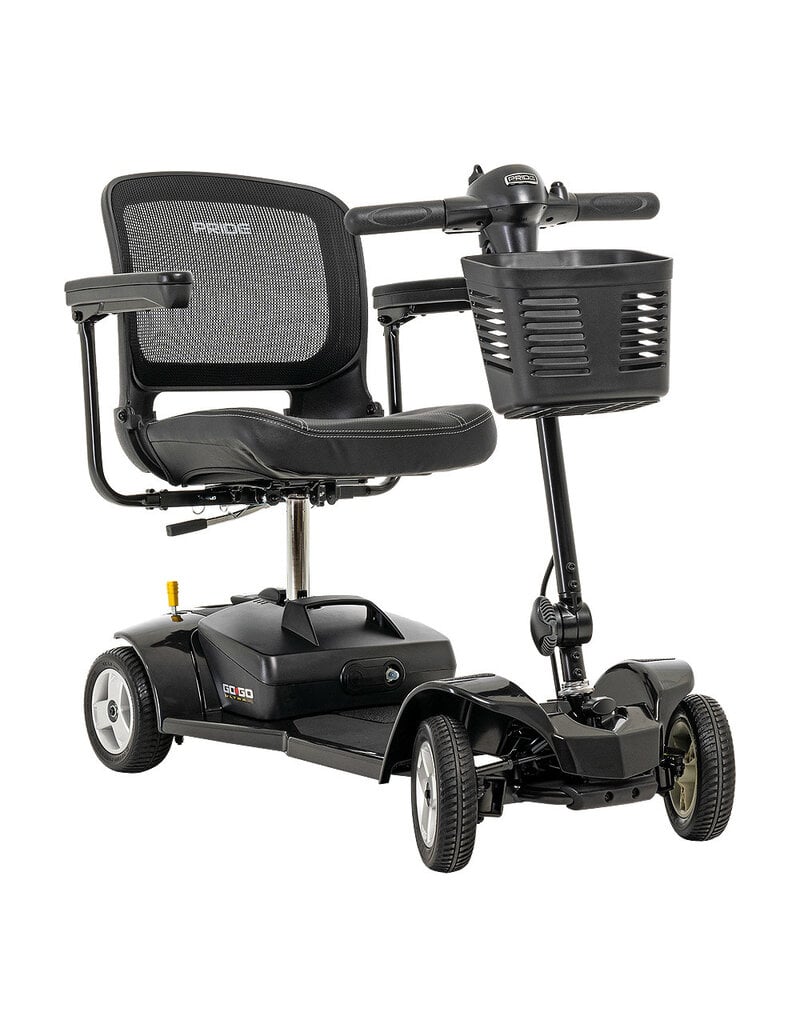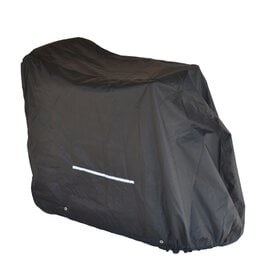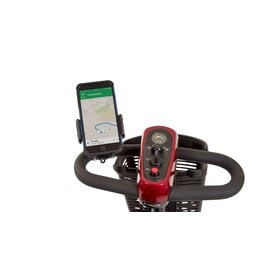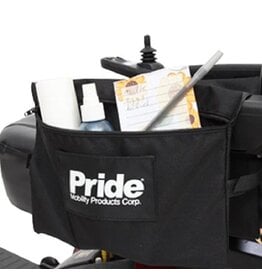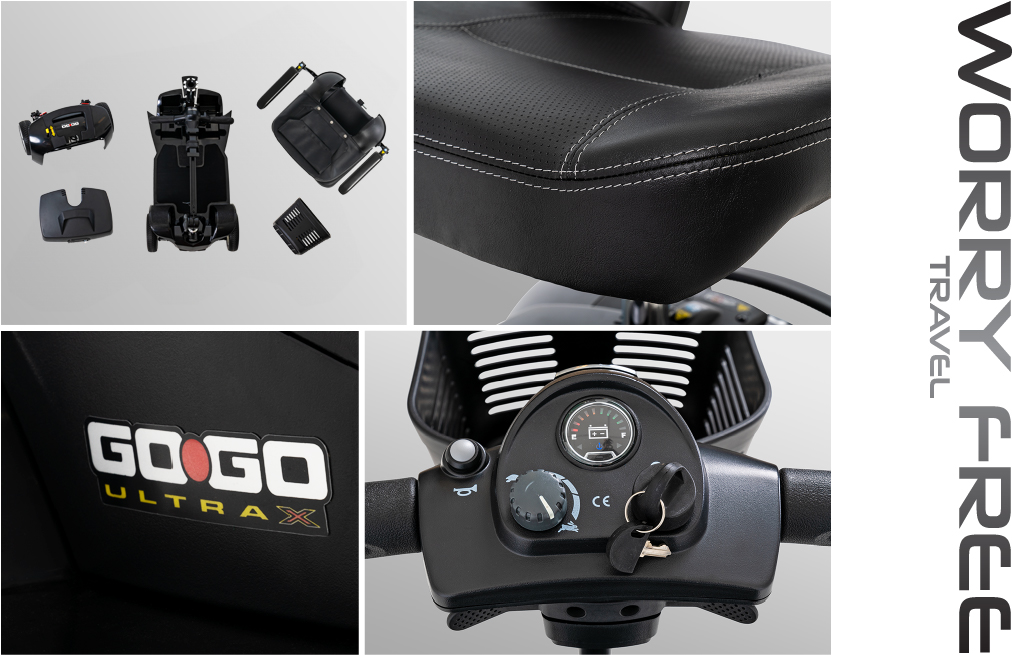
The Pride Go Go® Ultra X 4-Wheel (S49) is the four-wheel configuration of Pride's value-tier travel scooter — offering greater outdoor stability and longer range than the 3-wheel version at the cost of a wider turning radius. 300 lb. weight capacity, up to 4.1 mph, up to 8.9 miles per charge at 200 lbs. (6.6 miles at 300 lbs.), 52.25" turning radius. The same feather-touch one-hand disassembly into five pieces and drop-in battery box carry over from the 3-wheel — the heaviest piece is 34.5 lbs. (front section). Dual charging ports on tiller and battery box, compact foldable 17"×17" seat, standard front basket, non-scuffing tires. HCPCS Code K0800 — Group 1 Standard (Medicare-codable). Lifetime limited warranty on frame. Black only. Also available as the 3-wheel S39 with a tighter 36.5" turning radius.
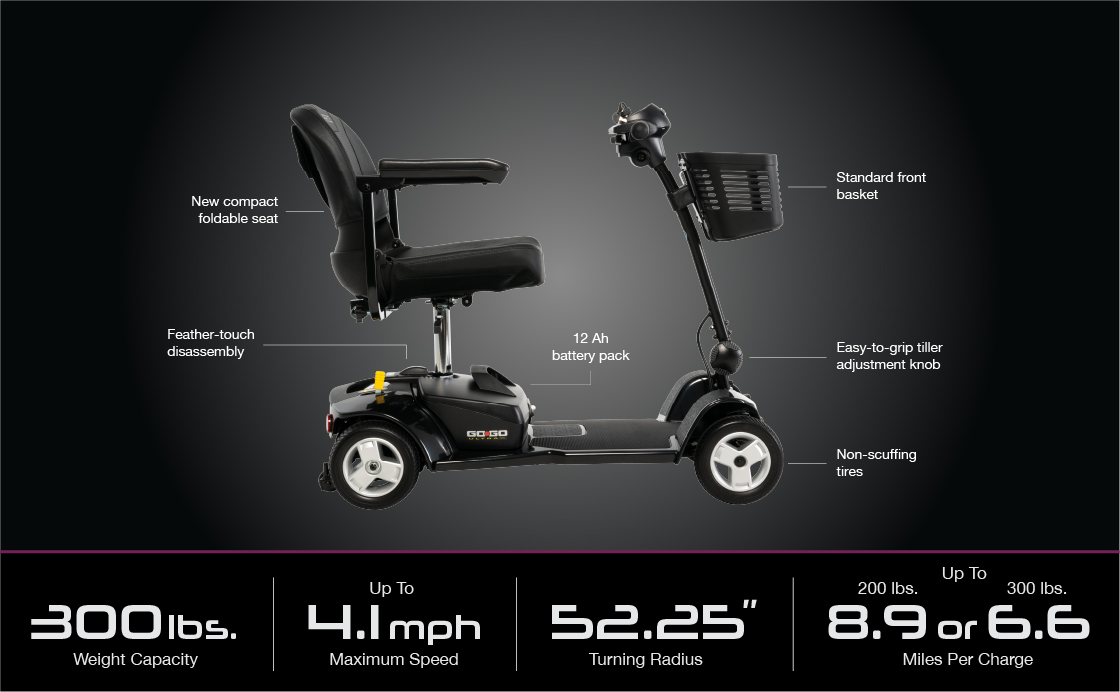
The 4-wheel Ultra X is the right choice when outdoor confidence matters more than tight turning. The fourth wheel extends the rear wheelbase, giving the scooter a more planted, stable feel on uneven pavement, grass edges, gravel paths, and inclines — the kinds of surfaces where 3-wheel scooters can feel tippy. The tradeoff is a 52.25" turning radius vs. 36.5" on the 3-wheel, which is a real consideration for regular indoor use in tighter spaces. The 4-wheel also delivers slightly longer range — up to 8.9 miles at 200 lbs. vs. 8 miles on the 3-wheel — though both use the same two 12 Ah batteries and 24V motor.
The primary reason to choose the 4-wheel Ultra X over the 3-wheel is stability on real-world outdoor surfaces. A 3-wheel scooter pivots on a single front wheel, which provides an excellent turning radius but less resistance to lateral tipping on cambered surfaces, soft ground, or uneven terrain. Four-wheel scooters distribute weight across a wider rear footprint, which makes them more forgiving on outdoor surfaces that aren't perfectly flat. For a user who primarily rides outdoors — neighborhood sidewalks with grade transitions, parking lots, garden centres, outdoor shopping areas — the 4-wheel's stability is worth the wider turning radius. For someone who primarily uses the scooter indoors and occasionally takes it outside, the 3-wheel S39 is usually the better balance. Full 3-wheel vs. 4-wheel comparison →
Both the 3-wheel and 4-wheel Ultra X share the same feather-touch disassembly system and drop-in battery box. The scooter separates into five pieces with a single-hand release — no tools. The 4-wheel's heaviest piece is the front section at 34.5 lbs., 5 lbs. heavier than the 3-wheel's 29.5 lbs. front section, due to the additional front wheel hardware. Still manageable for most users loading the scooter into a car trunk independently. The drop-in battery box removes the two 12 Ah batteries straight up from the top without disconnecting wiring — the same convenience carries over from the 3-wheel. Dual charging ports on both the tiller and the battery box mean you can charge from whichever location is more accessible. About disassembly →
"When a customer tells me they spend most of their time outdoors — neighborhood walks, shopping center parking lots, the zoo with the grandkids — I steer them toward the 4-wheel. The wider turning radius is a real thing in tight indoor spaces, but outdoors you rarely notice it. What you do notice is how much more confident the 4-wheel feels when the ground isn't perfectly flat. Same K0800 Medicare code, same battery box, same disassembly system — just more grounded."
Jake
General Manager & DME Expert — Broadway Home Medical, Wichita KS
Like the 3-wheel version, the 4-wheel Ultra X carries HCPCS code K0800 — Group 1 Standard power-operated vehicle. This is a defined Medicare billing code that provides a reimbursement pathway for eligible patients with documented medical necessity — unlike K0899-coded scooters which have no defined Medicare pathway. Eligibility requires a face-to-face physician evaluation, documented mobility limitations, and a qualifying diagnosis. Broadway Home Medical can help you understand the process and documentation requirements for both the 3-wheel and 4-wheel versions. About Medicare coverage →
| Model | S49 (4-wheel) |
|---|---|
| Weight Capacity | 300 lbs. |
| Maximum Speed | Up to 4.1 mph |
| Range Per Charge | Up to 8.9 miles (200 lbs.) / Up to 6.6 miles (300 lbs.) |
| Turning Radius | 52.25" |
| Overall Length | 40.25" |
| Overall Width | 19.25" |
| Ground Clearance | 3.23" at deck / 1.25" at motor |
| Total Weight (with batteries) | 101 lbs. |
| Total Weight (without batteries) | 81.5 lbs. |
| Heaviest Piece (disassembled) | 34.5 lbs. (front section) |
| Batteries | Two 12 Ah — 9 lbs. each |
| Battery Charger | Off-board, 2 amp |
| Charging Ports | Tiller and battery box |
| Motor | 24V DC, sealed transaxle |
| Brakes | Regenerative and electromechanical |
| Tires — Front | 2" × 8" |
| Tires — Rear | 2.5" × 8" |
| Seat | 17"×17" compact foldable — black vinyl |
| Seat-to-Ground Height | 21.5"–23" (adjustable) |
| Color | Black only |
| HCPCS Code | K0800 — Group 1 Standard |
| FDA Classification | Class II Medical Device |
| Warranty — Frame | Lifetime limited |
| Warranty — Electronics / Drivetrain | 2 years limited |
Common questions from customers at Broadway Home Medical considering the Go Go Ultra X 4-wheel.
The 4-wheel S49 is better for outdoor use and uneven terrain — the wider rear wheelbase provides more stability on cambered sidewalks, gravel, grass edges, and sloped surfaces. The 3-wheel S39 has a tighter turning radius (36.5" vs. 52.25") and is better for indoor use and tight spaces. The 4-wheel also delivers slightly more range (up to 8.9 miles at 200 lbs. vs. 8 miles). The 4-wheel's heaviest piece is 34.5 lbs. vs. 29.5 lbs. on the 3-wheel. If you primarily ride outdoors, choose the 4-wheel. If primarily indoors or in tight spaces, the 3-wheel is usually the better choice.
The 4-wheel Ultra X uses the same feather-touch one-hand disassembly system as the 3-wheel — a single-hand release separates the scooter into five pieces without tools. The front section is the heaviest piece at 34.5 lbs. The drop-in battery box lifts straight out from the top without disconnecting any wiring. The 4-wheel total weight without batteries is 81.5 lbs. vs. 76.25 lbs. for the 3-wheel — 5 lbs. more across all pieces due to the additional rear wheel hardware.
The 4-wheel S49 delivers up to 8.9 miles per charge at 200 lbs. on a flat surface, and up to 6.6 miles at the full 300 lb. capacity. This is slightly more than the 3-wheel's 8 miles at 200 lbs. — a result of the 4-wheel's rear wheel configuration reducing rolling resistance on flat surfaces. Actual range varies with rider weight, terrain, battery condition, and tire pressure.
Yes — the 4-wheel Ultra X carries HCPCS code K0800 (Group 1 Standard), the same Medicare-codable code as the 3-wheel. This provides a defined reimbursement pathway for eligible patients with documented medical necessity. Requirements include a face-to-face physician evaluation and documentation of mobility limitations. Broadway Home Medical can walk you through the process at either of our Wichita locations.
The 52.25" turning radius is manageable in most home environments but is noticeably wider than the 3-wheel's 36.5" in tight spaces like narrow hallways, small bathrooms, or cramped store aisles. If you're using the scooter primarily indoors, the 3-wheel is the more practical choice. If your home has standard doorways and open floor plans and you primarily ride outdoors, the 4-wheel's wider radius is rarely a limitation in day-to-day use.
The Go Go Ultra X 4-wheel carries a lifetime limited warranty on the frame, a 2-year limited warranty on electronics, and a 2-year limited warranty on the drivetrain. Pride is not responsible for labor, service calls, or shipping for repairs. Contact Broadway Home Medical for full warranty terms.
The Go Go Ultra X 4-wheel is available at Broadway Home Medical, Wichita's largest DME store. Stop by either of our two locations to see both the 3-wheel and 4-wheel versions in person and compare how each feels for your specific use case. If you're exploring Medicare coverage, our staff can walk you through the K0800 eligibility and documentation process.
Pride® FDA Class II Medical Devices are designed to aid individuals with mobility impairments. Speed and range vary with user weight, terrain type, battery charge, battery condition, and tire pressure. Specifications subject to change without notice. HCPCS code K0800 should not be considered legal advice and does not guarantee reimbursement — DME providers are responsible for determining appropriate billing codes. Payer coding, coverage, and bundling guidelines may apply.
This scooter is the perfect size for me. My husband can easily load this into the trunk of our car.